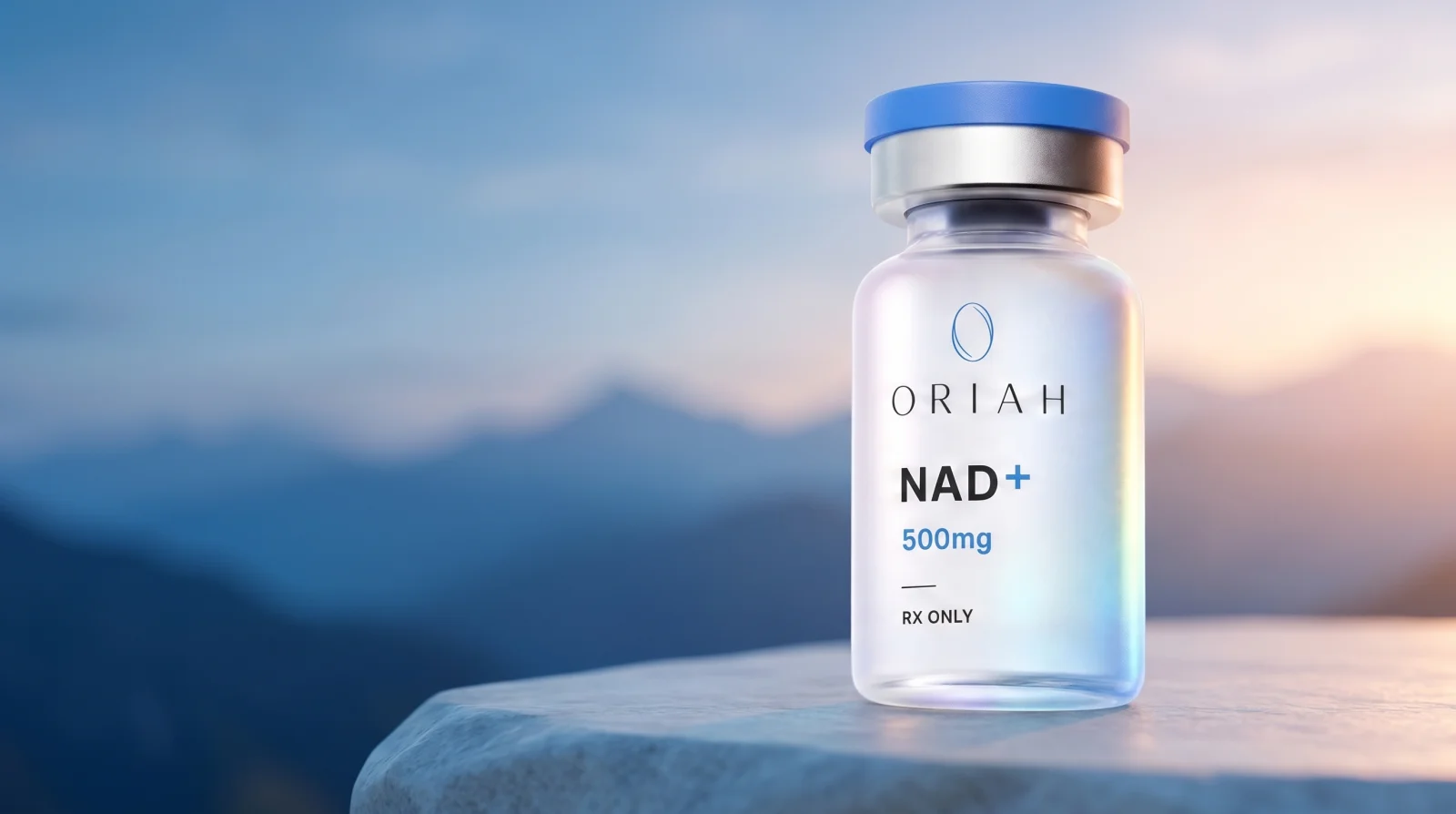
You make most of your growth hormone in a few sharp bursts during deep sleep, not as a steady trickle across the day. That one fact about your own physiology explains nearly everything about sermorelin: why it goes in at night, what it can actually do for you, and why it gets called gentler than the synthetic HGH it keeps getting mistaken for.
What sermorelin actually is
Sermorelin copies the working end of your body's own growth-hormone-releasing hormone, or GHRH. It reproduces the first 29 amino acids of natural GHRH, the stretch that carries the signal. When it reaches the pituitary gland at the base of your brain, it tells the cells there, the somatotrophs, to release growth hormone the same way they do when no one is intervening.
That detail carries the whole argument. Sermorelin delivers no growth hormone of its own. It nudges the gland that makes yours to make a bit more, while your pituitary stays in charge. The safeguards that decide how much gets released stay switched on.
Sermorelin versus synthetic HGH: opposite directions
Recombinant HGH is the synthetic form of growth hormone itself, injected straight into the bloodstream. It skips the pituitary completely. With the hormone arriving from outside, your body reads the high levels and dials down its own production, and IGF-1, the downstream marker of growth hormone activity, can climb past the range your physiology would normally hold it to. Those steady, non-pulsatile levels are not the way your body was built to receive this signal.
A regulatory line runs through this too. HGH carries no approval for anti-aging use, and prescribing it for that purpose sits under legal restriction. That restriction is one reason the supervised, lab-monitored peptide route exists as the responsible option, rather than chasing synthetic growth hormone off-label.
| Sermorelin (GHRH) | Synthetic HGH | |
|---|---|---|
| What it does | Signals your pituitary to release your own GH | Adds GH directly to the bloodstream |
| Release pattern | Natural pulses, mostly at night | Sustained, non-pulsatile levels |
| Feedback loops | Preserved, including the somatostatin brake | Bypassed; can suppress your own production |
| IGF-1 effect | Nudged toward a healthy physiologic range | Can reach supraphysiologic levels |
| Status for anti-aging | Prescription, compounded, supervised | Not FDA-approved; restricted off-label |
Where ipamorelin fits in
Read about peptides for ten minutes and you hit the alphabet soup: sermorelin, ipamorelin, GHRP, IGF-1. Ipamorelin earns its own paragraph because it belongs to a different class. Sermorelin is a GHRH analog that behaves like your releasing hormone. Ipamorelin is a GHRP, a ghrelin-receptor mimetic, and it triggers growth hormone release through a separate pathway.
The two pathways complement each other rather than overlap, so clinicians sometimes pair a GHRH peptide with a GHRP. The combination can produce a fuller, more natural-feeling pulse than either one alone. Whether that pairing suits you is a clinical call that turns on your labs and your goals, not a default setting.
What it can realistically help with
Growth hormone and IGF-1 output drift down as you age, a slow decline sometimes called somatopause. It helps explain why sleep turns lighter, why training takes longer to bounce back from, and why fat tends to settle around the middle even when your effort has held steady. GHRH peptides aim to coax that GH axis back toward a healthier physiologic range.
What people report in practice tends to be better sleep quality, quicker recovery between workouts, and gradual changes in body composition across weeks to months. These are real effects for many people, but they show up individually and they build slowly. Nothing here happens overnight. The honest caveat is that the evidence in healthy aging adults, as opposed to people with a diagnosed deficiency, stays limited, which is the case for a measured, lab-guided approach over a sales promise.
“The peptide is only half of it; the monitoring is the rest. We check a baseline IGF-1, start low, and confirm we're moving growth hormone into a healthy pulse, not pushing it past where your body wants it.”
Why it's dosed at night
Your biggest natural growth-hormone pulse lands during deep, slow-wave sleep. A subcutaneous dose before bed rides that existing rhythm instead of fighting it. The timing is part of what keeps the approach physiologic, since it amplifies a pulse your body was already set to produce rather than dropping growth hormone in at a moment your system never asks for it.
The monitoring that holds it together
You can't feel your IGF-1 level, which is exactly why responsible programs measure it. IGF-1 is the standard downstream biomarker clinicians use to titrate any growth-hormone-axis therapy. A baseline reading before you start, then follow-up labs after, confirm the peptide is doing its one job: moving your output into a healthy range and keeping it there.
- Baseline IGF-1 before starting, so you know where you actually sit.
- Follow-up IGF-1 to confirm the dose lands you in a physiologic range and not past it.
- Glucose and A1c checks, because growth hormone can change insulin sensitivity.
- Clinician dose titration driven by those numbers instead of a fixed one-size protocol.
- A full medical-history review up front, including any cancer history.
Safety, side effects, and who it doesn't suit
For the right candidates under supervision, GHRH peptides tend to be well tolerated. The common side effects stay mild: a reaction at the injection site, some flushing, light water retention, the occasional headache. Because growth hormone influences insulin sensitivity, glucose tracking belongs to safe oversight rather than sitting on it as an optional add-on.
The screening point that matters most is plain. Active or recent cancer rules it out, because growth hormone and IGF-1 signaling can affect how cells proliferate. That fact is the reason a clinician reads your full history before anything gets prescribed. If the therapy isn't right for you, you won't be prescribed it, and that screening counts as part of the process working, not a hoop to clear.
Who it tends to suit
It tends to fit healthy aging adults, often in their late thirties through fifties, who are feeling the specific changes the GH axis touches: lighter sleep, slower recovery, a body composition that drifts despite steady effort. The right candidate is someone willing to be evaluated on their own bloodwork rather than someone hunting for a shortcut. Plenty of people who ask about it turn out to be better served by fixing sleep, training, or another hormone first, and a good clinician will say so.
Is sermorelin the same as HGH?
No. Sermorelin is a GHRH peptide that signals your pituitary to release your own growth hormone in natural pulses. Synthetic HGH adds growth hormone from outside and bypasses your pituitary. That difference is why the peptide approach keeps your feedback loops intact and gets described as gentler.
What does sermorelin actually help with?
People commonly report better sleep quality, faster recovery, and gradual changes in body composition over weeks to months. The effects are real but individual, and the evidence in healthy aging adults stays limited, so it's best judged against your own bloodwork and goals rather than treated as a guaranteed result.
Is it safe?
For the right candidates under medical supervision, GHRH peptides tend to be well tolerated, with mild side effects like injection-site reactions, flushing, or temporary water retention. Safety hinges on screening: active or recent cancer rules it out, and a clinician reviews your history and monitors IGF-1 and glucose to keep levels in a healthy range.
What's the difference between sermorelin and ipamorelin?
They work through different pathways. Sermorelin is a GHRH analog that acts like your natural releasing hormone, while ipamorelin is a GHRP that triggers GH release through the ghrelin receptor. Because the pathways complement each other, clinicians sometimes combine them for a fuller, more natural-feeling pulse.
Why is it taken at night?
Your biggest natural growth-hormone pulse happens during deep sleep, so a subcutaneous dose before bed is timed to work with that rhythm instead of against it. That timing is part of how the approach supports your physiology rather than overriding it.
Do I need bloodwork, or can I just order peptides online?
Bloodwork matters. IGF-1 is the marker clinicians use to confirm the peptide is moving your GH output into a healthy range and not too high, and glucose gets tracked because growth hormone can change insulin sensitivity. Ordering unregulated peptides online skips the screening, lab monitoring, and pharmaceutical-grade sourcing that make this safe. You can start with a quick assessment to see if a supervised plan fits you.
Medically reviewed by Oriah physicians
This article is for general education and is not medical advice. It does not replace a consultation with a licensed clinician. Prescription treatments require an evaluation, and eligibility depends on your health history and labs. If you have a medical concern, talk with a physician.