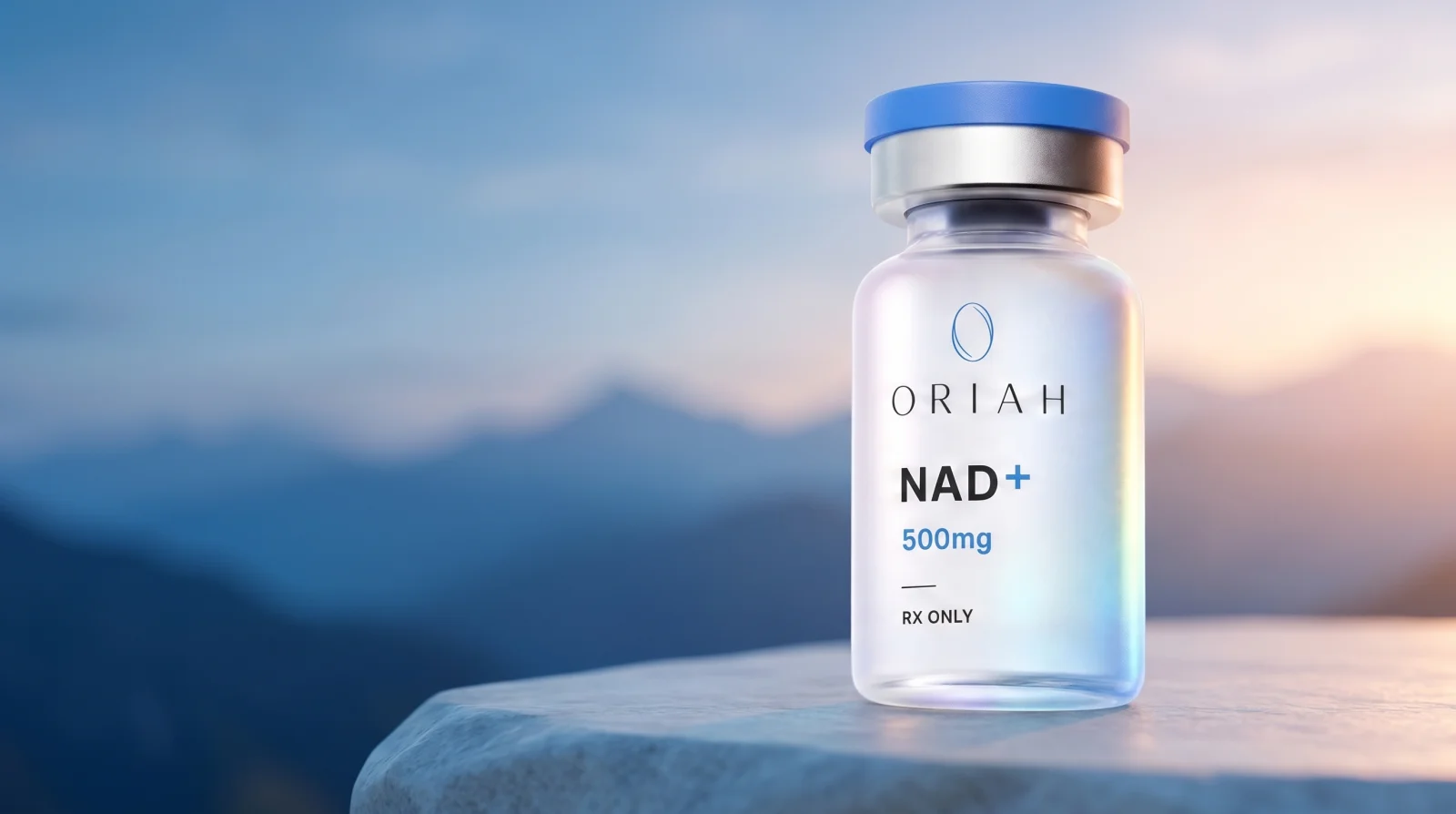
NAD+ turns up in almost every longevity pitch, usually wired to a promise about energy, aging, or cellular repair. Some of that rests on real biology. A good deal of it runs well ahead of the evidence. NAD+ is a coenzyme your cells genuinely depend on, its levels do fall as you get older, and raising it is an active research question rather than a settled answer. Separating the mechanism from the marketing is worth doing before you spend a dollar on it.
What NAD+ actually does
Picture the last step of how a meal becomes usable fuel. Inside your mitochondria, nutrients get broken down and their energy is shuttled along a chain of reactions that ends in ATP, the currency your cells spend on everything from muscle contraction to thinking. NAD+ is one of the molecules that carries electrons through that chain. Without enough of it, the hand-off slows, and energy production along with it.
Its second job is repair. NAD+ is the fuel for two families of enzymes that maintain your cells: sirtuins, which help regulate metabolism and the stress response, and PARPs, which patch damaged DNA. Both literally consume NAD+ to work. That detail matters, because it means NAD+ is not just used as a catalyst and recycled forever. It gets spent, and your cells have to keep making more.
Why NAD+ falls as you age
Two things drift in the wrong direction over time. Your cells make somewhat less NAD+, and they burn through more of it. Chronic low-grade inflammation and rising activity of an NAD+-consuming enzyme called CD38 both pull from the same pool, while ongoing DNA repair keeps the PARPs drawing it down. The result is a slow net decline that shows up in many tissues by middle age.
What the evidence actually shows
Start with the part that is well established. In controlled human trials, NAD+ precursors such as nicotinamide riboside (NR) and nicotinamide mononucleotide (NMN) reliably raise the amount of NAD+ circulating in your blood. That much is not in serious dispute. Supplementing moves the number.
The harder question is what that higher number does for you. Here the research is younger and the results are mixed. Some trials report improvements in specific measures like blood pressure or markers of metabolic health in particular groups; others show a clear rise in NAD+ with no obvious change in how participants feel or perform. Most of the dramatic lifespan and reversal stories come from animal or cell studies, which do not automatically carry over to people. The honest summary: the mechanism is real, the ability to raise NAD+ is real, and the everyday payoff is still being measured.
“I tell patients NAD+ is promising, not magic. We can reliably raise the level. What we are still learning is who benefits most and by how much, so we treat it as a measured experiment with a baseline, a dose, and a check-in, not a leap of faith.”
IV, injection, or oral precursor?
Most people meet NAD+ in one of three forms. They differ less in whether they work and more in absorption, convenience, and what they cost you in time and money.
| IV / injectable NAD+ | Oral precursors (NR / NMN) | |
|---|---|---|
| What it is | NAD+ delivered directly, by drip or subcutaneous shot | A building block your body converts into NAD+ |
| Absorption | Bypasses the gut; high availability | Goes through digestion first; reliably raises blood NAD+ |
| Experience | IV drips can take time and may feel intense if pushed fast | A daily capsule, easy to keep up |
| Best for | People who want direct dosing under supervision | People who want a simple, steady daily routine |
| Cost and effort | Higher per session, less convenient | Lower per day, very convenient |
None of these is automatically the right one. The fit depends on your goals, your budget, how your body responds, and what you will actually stick with. That last point quietly decides most outcomes, because a protocol you abandon does nothing.
How to weigh it, without the hype
If you are considering NAD+, a few habits keep you on the right side of the evidence:
- Set the expectation first. Treat it as a possible edge on energy and metabolic health, not a cure for aging. Judge it against your own baseline.
- Cover the fundamentals. Sleep, regular exercise, and good metabolic health support your natural NAD+ production. No injection substitutes for those.
- Mind the source. Supplement quality and dosing vary widely, and the label does not always match the bottle. This is where oversight matters.
- Measure something. A starting point and an honest check-in a few weeks later beat going on a feeling.
How Oriah approaches NAD+
Oriah treats NAD+ as a clinical decision rather than a menu item. That means a physician reviews your history and labs first, you get a pharmaceutical-grade product at a sensible dose, and your response is monitored over time so the plan can be adjusted or stopped. It is personalized to your biology and folded into the rest of your protocol, which is how a supplement with real but still-maturing evidence is best used. You can see whether you are a candidate through the Oriah assessment.
Does NAD+ supplementation actually work?
It reliably does one thing: precursors like NR and NMN raise the NAD+ in your blood, and that is well supported in human trials. Whether that higher level changes how you feel or age is still being studied, with mixed early results. The mechanism is real; the size of the everyday benefit is what researchers are still pinning down.
Is IV NAD+ better than oral NMN or NR?
Not necessarily. IV and injectable forms deliver NAD+ directly and bypass digestion, while oral precursors are simpler and still reliably raise blood levels. The better choice depends on your goals, budget, and what you will keep up with. A clinician can help you match the form to your situation.
Is NAD+ safe?
For most people it is well tolerated. IV drips pushed too quickly can cause temporary flushing or chest tightness, which is one reason supervised dosing matters. It is not appropriate for everyone, so a medical review comes first.
How fast would I notice anything?
Blood NAD+ rises within days of starting precursors, but any subjective change, if it comes, tends to be gradual and varies a lot between people. This is a case for measuring a baseline and checking back in a few weeks rather than judging it overnight.
NMN or NR — which precursor is better?
Both raise blood NAD+ in trials and both are widely used. The research has not crowned a clear winner for everyday outcomes, so quality, dose, and consistency usually matter more than the specific molecule. Your provider can help you choose.
Can I just boost NAD+ naturally?
To a degree, yes. Regular exercise, solid sleep, and good metabolic health all support your body's own NAD+ production, and they are the foundation any supplement is meant to build on, not replace.
Medically reviewed by Oriah physicians
This article is for general education and is not medical advice. It does not replace a consultation with a licensed clinician. Prescription treatments require an evaluation, and eligibility depends on your health history and labs. If you have a medical concern, talk with a physician.