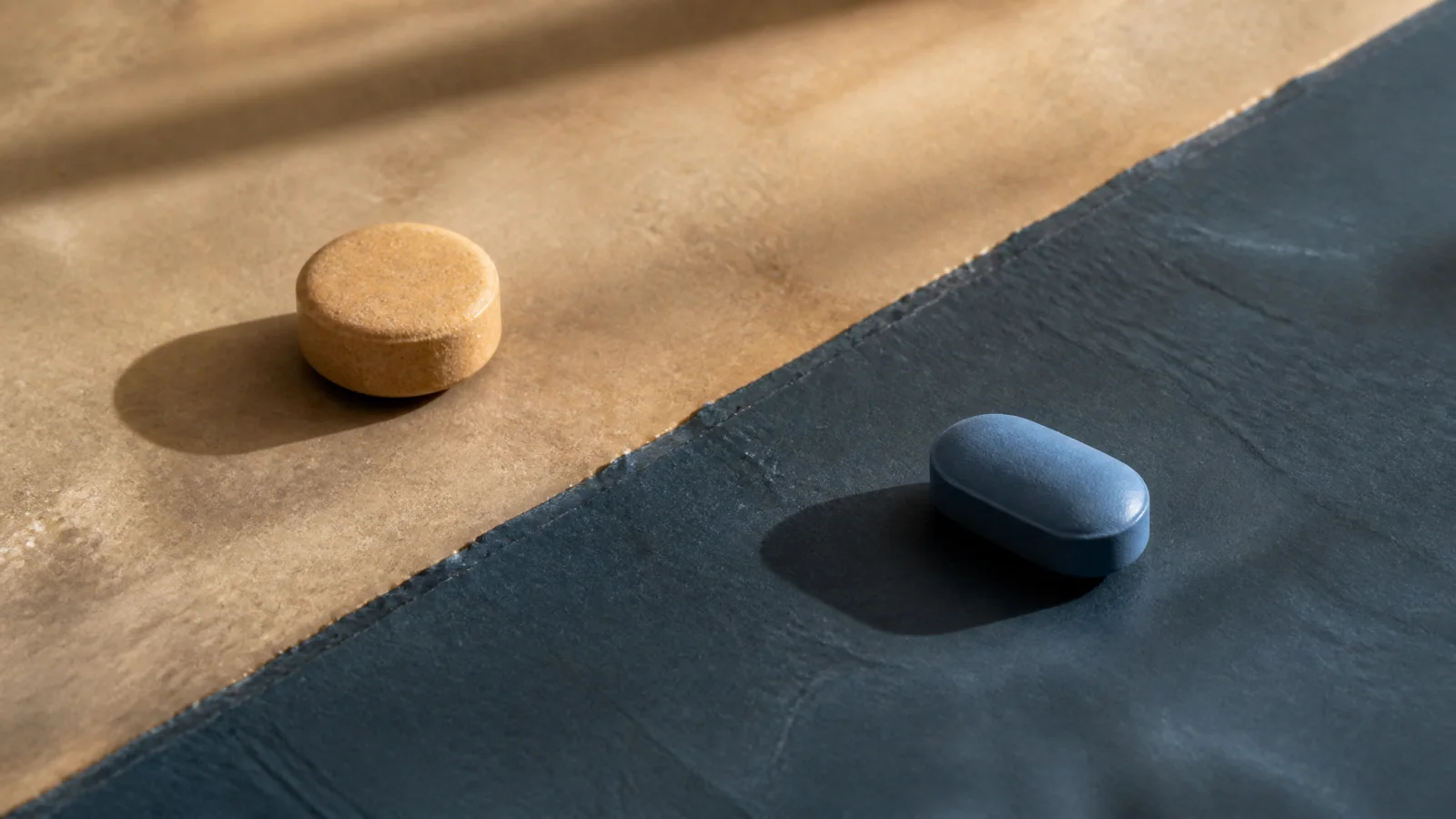
Erectile dysfunction gets treated like a punchline or a verdict on your manhood. The biology is calmer than that. Most of the time it comes down to blood flow and signaling, the mechanism is well mapped, and the pills that treat it are among the most-studied prescriptions in modern medicine. Once you understand how they work, you're choosing instead of guessing.
How the medication actually works
An erection is a plumbing event before it's anything else. When you're aroused, nerves release nitric oxide in the penis, which raises a messenger molecule called cyclic GMP. That messenger relaxes the smooth muscle lining the small arteries, blood flows in, and the tissue firms up. Afterward your body clears the cyclic GMP using an enzyme called phosphodiesterase type 5, or PDE5. That enzyme is the off-switch that lets everything settle back to baseline.
Sildenafil and tadalafil are PDE5 inhibitors. They slow that off-switch. With the enzyme working less aggressively, cyclic GMP sticks around longer, the nitric-oxide signal holds, and blood flow becomes easier to reach and keep. That one mechanism is the entire pharmacology, and it explains the most common complaint men have about these pills.
Sildenafil vs tadalafil: same engine, different clock
Both drugs do the same thing chemically. What separates them, and what decides which one fits your life, is how long each stays active in your body. Sildenafil takes effect in roughly 30 to 60 minutes and works for about 4 to 6 hours, so men usually take it when they expect sex. A heavy or high-fat meal can slow its absorption and delay when it kicks in.
Tadalafil has a much longer half-life, around 17.5 hours, and an effective window of up to roughly 36 hours when taken as needed. That long tail earned it the weekend-pill nickname, and it's also why tadalafil comes in a low-dose daily form. Take a small amount every day and you skip the timing math, so intimacy doesn't have to be scheduled around a tablet. Food affects tadalafil less than it affects sildenafil.
| Sildenafil | Tadalafil | |
|---|---|---|
| Typical onset | ~30-60 min | ~30-60 min |
| Effective window | ~4-6 hours | up to ~36 hours (as needed) |
| Half-life | ~4 hours | ~17.5 hours |
| Daily option | Less common | Yes, low-dose daily for spontaneity |
| Food sensitivity | Heavy or fatty meals can slow onset | Less affected by food |
| Best suited to | Planning around a known occasion | Wanting it to feel unplanned |
Underneath the chemistry sits a plain lifestyle question: do you prefer to plan, or do you want erections to feel spontaneous without watching the clock? As-needed dosing suits men who are fine taking something an hour ahead. Low-dose daily tadalafil suits men who'd rather not think about it at all. Neither wins in the abstract. The right pick depends on your health history, your other medications, and how you actually live, which makes it a clinician's call rather than a self-diagnosis off a comparison table.
“When a man tells me the pill didn't work, my first question isn't about the dose. I want to know whether anyone ever checked what sits underneath it: the blood pressure, the blood sugar, the testosterone. Treating the erection while ignoring the engine behind it is how men stay frustrated and in the dark.”
Why ED can be a signal, not just a symptom
This is the part that turns ED from an embarrassment into useful information. The arteries that supply the penis are small, narrower than the coronary arteries feeding your heart. When the lining of your blood vessels (the endothelium) starts to falter, the smallest vessels tend to show it first. That's why erectile difficulty can precede cardiovascular disease by years. The symptom you'd most like to ignore can be one of the earliest windows into your vascular health.
The usual contributors to ED read like a checklist of general health: high blood pressure, diabetes and insulin resistance, obesity, smoking, heavy drinking, poor sleep, certain prescription medications, and psychological factors like stress and performance anxiety. Low testosterone belongs there too, since it can dull both libido and the strength of the response. That's part of why hormones are worth measuring when blood flow alone doesn't explain the picture.
- Cardiovascular and endothelial health: blood pressure, cholesterol, vessel function
- Metabolic factors like blood sugar, insulin resistance, and weight
- Hormones, especially testosterone, which shapes desire and response
- Lifestyle inputs such as sleep, alcohol, smoking, and chronic stress
- Side effects from some blood-pressure and antidepressant medications
None of this is meant to scare you. Plenty of ED is situational, stress-driven, or tied to one fixable factor. The point is that a responsible evaluation treats the erection and asks what's driving it, because addressing the cause can improve both the problem and the rest of your health at once.
Safety: the one rule you can't skip
For most men PDE5 inhibitors are well tolerated, with the common side effects being headache, flushing, nasal congestion, and mild indigestion. They are still prescription medications for a reason. You must never combine them with nitrate medications such as the nitroglycerin used for chest pain. Both lower blood pressure, and together they can trigger a sudden, dangerous drop. Certain blood-pressure drugs, alpha-blockers especially, also call for caution and careful timing.
Counterfeit pills bought online carry their own hazard. They can be underdosed, overdosed, or contaminated, and you have no way to tell. Pharmaceutical-grade medication from a licensed pharmacy, prescribed after a genuine evaluation, removes that gamble. That's the baseline for safe treatment, not a luxury add-on.
Why bloodwork and supervision matter
It's fair to wonder whether labs are a real clinical step or just an upsell. The honest answer: bloodwork helps a physician confirm the medication suits you and check for contributors like low testosterone, blood sugar problems, or other factors that affect both your results and your safety. Treating the symptom while ignoring a fixable cause is poor medicine. Labs are what make the plan yours instead of generic.
A telehealth evaluation can be genuinely discreet without cutting corners. You complete a private health assessment online, a board-certified physician reviews your information and labs, and if treatment is appropriate, pharmaceutical-grade sildenafil or tadalafil can be prescribed from a licensed pharmacy and shipped to you. It's available in all 50 states, no insurance required, with transparent pricing. If it isn't right for you, you won't be prescribed it, and that filter is the system doing its job.
And no, treatment isn't necessarily forever. For some men ED is situational or eases as underlying factors like weight, blood pressure, sleep, and hormones improve. PDE5 inhibitors can be used as needed or daily, and a clinician can adjust the plan over time as your health shifts. Using a tool while you work on root causes is a long way from being stuck with it.
What's the real difference between sildenafil and tadalafil?
Both improve blood flow to support an erection when you're aroused. The practical difference is timing. Sildenafil works for about 4 to 6 hours and gets planned around activity; tadalafil lasts up to roughly 36 hours as needed and also comes in a low daily dose for spontaneity. Which one fits depends on your health history and lifestyle, which a clinician helps decide.
Do these pills give you an automatic erection?
No. They make your body's normal response to arousal more reliable, but you still need sexual stimulation for them to work. They support the blood flow, not the desire.
Is erectile dysfunction a sign of a bigger health problem?
It can be. Because the arteries in the penis are small, they often reveal blood-vessel problems before the heart does, so ED can be an early flag for cardiovascular or metabolic issues. It can also tie to low testosterone, blood sugar, blood pressure, medications, sleep, or stress. That's why a responsible evaluation looks at the whole picture.
Is it safe to take ED medication?
For most men it's well tolerated, but it isn't right for everyone. The most important rule: never combine PDE5 inhibitors with nitrate medications like nitroglycerin, because that can cause a dangerous blood-pressure drop. Some blood-pressure drugs also need caution. This is why a clinician reviews your history first.
Do I really need bloodwork to get treated?
Bloodwork isn't a hoop for its own sake. It helps a physician confirm the medication is appropriate and check for contributors like low testosterone or metabolic issues that affect both results and safety. Labs are what make the plan personalized rather than one-size-fits-all.
Can I get treated without an awkward in-person visit?
Yes. A telehealth evaluation lets you complete a private assessment online, have a board-certified physician review your information and labs, and, if appropriate, receive pharmaceutical-grade medication from a licensed pharmacy, available in all 50 states. You can begin the assessment here.
If you're rating your interest from 1 to 10, here's a fair way to use the number. At a 7 or higher on wanting to deal with this, the assessment is the obvious next step, and it's built to tell you whether treatment fits. Lower than that, keep reading and take your time. There's no countdown. A few minutes whenever you're ready buys you a straight answer instead of more guessing.
Medically reviewed by Oriah physicians
This article is for general education and is not medical advice. It does not replace a consultation with a licensed clinician. Prescription treatments require an evaluation, and eligibility depends on your health history and labs. If you have a medical concern, talk with a physician.