On a GLP-1, your appetite can drop faster than your kitchen habits adjust. In the first weeks on semaglutide or tirzepatide, a lot of people get full after four or five bites, skip meals without noticing, then go shaky by mid-afternoon. That is the medication working. What it can't decide for you is whether the weight you lose comes off mostly as fat, or partly as muscle you'll want back later.
Why your appetite falls off in the first weeks
GLP-1 medications copy a hormone your gut already releases after you eat. Semaglutide and tirzepatide mimic that signal and make it last, and they do two things at once. They slow gastric emptying, so food sits in your stomach longer and fullness arrives sooner. They also act on satiety centers in the brain, so the pull to keep eating fades early and the constant food noise goes quiet. That pairing is the entire point of the drug, and it explains why intake can drop hard once you start, with the strongest effect usually in the first one to three months.
In practice you have less room and fewer total bites than you're used to. A day that once ran past 2,000 calories without a second thought can leave you unable to finish a single chicken breast. That is the drug doing its job, but it also means generic advice to eat balanced meals stops being enough, because the volume to balance simply isn't there. Every bite now has to earn its spot on the plate.
The muscle-loss risk nobody warns you about
The before-and-after photos skip this part. When you lose weight quickly, some of what leaves is lean mass, not only fat. Weight-loss research often puts lean tissue at roughly a quarter to a third of total weight lost when protein and strength work aren't prioritized. So someone who drops 30 pounds on autopilot can give up a real share of it as muscle, the tissue that keeps metabolism resilient and keeps you strong as you age.
You can't take that number to zero, but you can move it a lot. The two levers with the most support in nutrition and obesity-medicine research are easy to state and harder to do every day: eat enough protein, and train against resistance. Protein delivers the amino acids your body uses to hold muscle through a calorie deficit. Lifting signals that the muscle is still in use and worth keeping. Do both and more of what you lose shifts toward fat, which was the goal.
“The injection handles hunger. How much of your loss is fat you wanted gone, versus muscle you'll miss, comes down to what goes on the plate and whether you train.”
Those trial figures are well established, but read them as averages across thousands of supervised participants, not a promise for any one body. Individual results move with dose, nutrition, activity, and medical oversight. They matter here mainly as a measure of how much weight can come off, which is the reason protecting lean mass on the way down counts for so much.
How much protein, in real food, not just grams
A grams-per-kilogram target reads clean on paper and means little at the fridge. Translate it. At roughly 80 kg, about 175 pounds, the 1.0 to 1.6 g/kg range lands somewhere near 80 to 130 grams of protein a day. Many clinicians simplify that into a daily floor, often near 80 to 100-plus grams, then adjust up for higher body weight, more training, or specific goals. The right number for you depends on your weight, your activity, and your labs, which is why a clinician should set it rather than a guess.
The skill on a GLP-1 is hitting that target out of a much smaller appetite, so you want foods that pack protein into little volume. A few workhorses worth keeping on hand:
- Two eggs plus a couple of egg whites land around 18 to 20 grams and sit easy on the stomach.
- A cup of plain Greek yogurt or low-fat cottage cheese gives about 18 to 25 grams in a small bowl.
- A palm-sized piece of chicken, turkey, fish, or lean beef runs roughly 25 to 30 grams.
- Firm tofu or tempeh covers about 15 to 20 grams per serving for plant-based eaters.
- A protein shake or ready-to-drink option usually hits 20 to 30 grams, handy on days solid food feels like a wall.
Fiber and hydration against the GI side effects
Constipation is one of the most common complaints on a GLP-1, and it follows directly from eating less. Less food means less fiber and less of the water that comes packaged inside food. Aim for about 25 to 35 grams of fiber a day, the standard adult guidance, from berries, leafy greens, beans and lentils, oats, chia, and whole grains. Fiber also slows digestion in a useful way, smoothing blood sugar and stretching fullness between your small meals.
Hydration carries more weight now than it did before, because the water you used to pull from a larger volume of food dropped along with everything else. Falling short on fluids worsens the exact problems people pin on the medication: fatigue, headaches, constipation. Keep water in reach and sip across the day instead of forcing big amounts at once, which only crowds an already-full stomach. If plain water feels like too much, sparkling water, broth, and unsweetened tea all count.
Eating to keep nausea in check
Nausea, early fullness, and reflux are common, and they tend to spike after a dose increase. Usually they stay mild to moderate and settle as your body adjusts and as titration is paced sensibly. A large share of how rough or smooth this feels traces back to behavior at the table, not the dose alone. The patterns that help most people:
- Eat smaller amounts more often. Three big meals can overwhelm a slowed stomach, while four or five mini-meals tend to settle better.
- Eat slowly and stop at comfortable fullness, not stuffed. The fullness signal arrives early and hits hard on these drugs.
- Go light on very greasy, fried, or high-fat meals. They empty slowly and trigger nausea more than anything else.
- Stay upright for a while after eating, since lying down soon makes reflux more likely.
- Keep sipping water through the day, because dehydration makes nausea worse.
A copyable day of eating on a GLP-1
Treat this as a template, not a prescription, built to hit protein and fiber in small volumes across the day. Scale portions to your appetite and your clinician's target, and keep the protein-first order at every stop.
- Morning: scrambled eggs with a little cheese, plus a few berries. Roughly 20 grams of protein in a small portion.
- Mid-morning: Greek yogurt with chia and a few raspberries. About 18 to 20 grams of protein and a useful fiber bump.
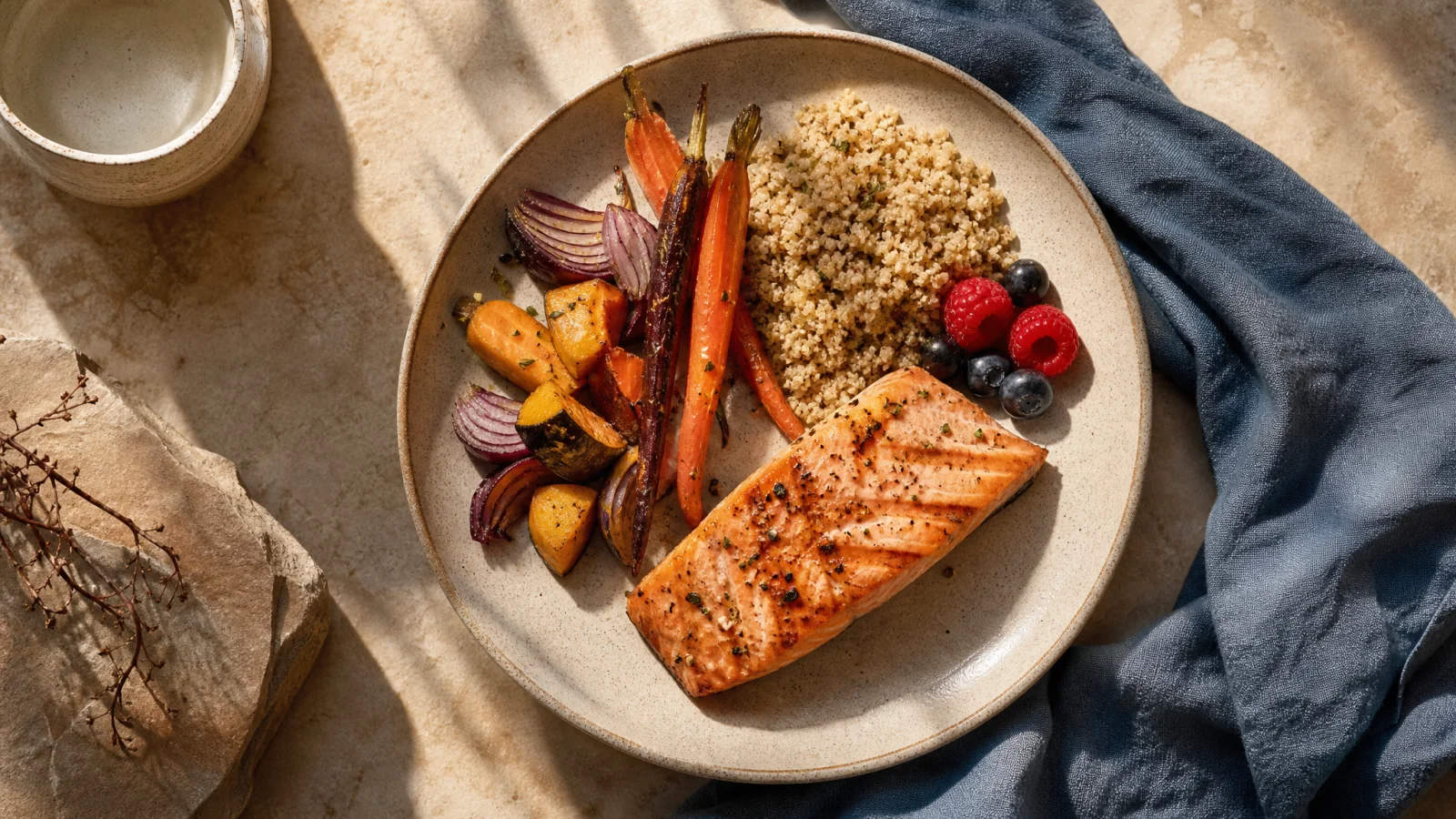
- Lunch: palm-sized grilled chicken or salmon, a handful of roasted vegetables, a small scoop of quinoa or beans. Around 30 grams of protein.
- Afternoon: cottage cheese with cucumber, or a protein shake on a low-appetite day. About 20 to 25 grams.
- Dinner: tofu or lean beef stir-fry heavy on protein and vegetables, lighter on oil. Roughly 25 to 30 grams.
- Through the day: water, unsweetened tea, or broth, sipped steadily.
Add those up and you sit comfortably in the 100-to-130-gram protein range with solid fiber, spread so no single meal has to be large. On a day your appetite vanishes, hit protein first and let the rest go. A shake that gets 25 grams in beats a perfect plate you couldn't finish.
| Adequate-protein deficit | Just eating less of everything | |
|---|---|---|
| Protein | Prioritized first, ~1.0-1.6 g/kg/day | Drops along with total food |
| Muscle on the way down | More protected when paired with training | More likely lost as lean mass |
| Energy and mood | Steadier through the day | Often shaky and depleted |
| After the weight comes off | Strength kept, metabolism more resilient | Higher risk of looking lean but losing function |
Where a supervised program changes the math
None of this runs as a single fixed protocol, which is the case for keeping a clinician in the loop instead of a prescription in the mail and a search bar for advice. Your protein floor tracks your weight and goals. Your dose pace tracks how well you tolerate it. Hair shedding, fatigue, or flat energy can sometimes trace to under-eating protein or to a nutrient worth checking on labs, and a self-directed approach has no way to catch that. Oriah's model is built around those adjustments: board-certified physicians, treatment matched to your bloodwork, ongoing lab monitoring and dose changes, available in all 50 states, with pharmaceutical-grade compounds from licensed pharmacies and transparent pricing from $99/mo, no insurance needed.
How much protein should I eat on a GLP-1?
A common clinical range during active weight loss is about 1.0 to 1.6 grams of protein per kilogram of body weight per day, and many people get a practical floor near 80 to 100-plus grams. Because appetite is suppressed, the move that works is eating protein first at every meal. Your exact target should be set with your clinician based on your weight, goals, and labs.
Will I lose muscle on semaglutide or tirzepatide?
Some lean mass can come off during any rapid weight loss, with estimates often around a quarter to a third of total weight lost if you take no steps to protect it. The two best-supported protections are eating enough protein and doing regular resistance training. Done consistently, they shift more of what you lose toward fat.
What should I eat when I can barely finish a meal?
Lead with the most protein- and nutrient-dense foods in smaller portions: Greek yogurt, eggs, cottage cheese, chicken, fish, tofu, or a protein shake. Add fiber-rich vegetables and a whole-food carb if you have room. Smaller, more frequent mini-meals usually beat three large ones when appetite is low.
Do I need protein shakes and supplements?
Not necessarily. Whole foods like eggs, Greek yogurt, cottage cheese, chicken, fish, and tofu can cover your protein needs on their own. Shakes are simply convenient for days when solid food is hard or your appetite is gone. A clinician can flag whether your labs point to a specific nutrient that needs attention.
How do I manage nausea from a GLP-1?
Eating behaviors help a lot: keep meals smaller, eat slowly, stop at comfortable fullness, and limit very greasy, fried, or high-fat foods. Staying hydrated and staying upright after meals reduce reflux. Nausea is common and usually eases with time and gradual dose adjustments. If it turns severe or persistent, talk to your clinician.
How much weight do people actually lose on these medications?
In the large clinical trials, average weight loss over roughly 68 to 72 weeks ran about 15% of body weight for semaglutide and up to roughly 20 to 22% for tirzepatide. Those are trial averages, not guarantees. Individual results vary with dose, nutrition, activity, and medical supervision.
Medically reviewed by Oriah physicians
This article is for general education and is not medical advice. It does not replace a consultation with a licensed clinician. Prescription treatments require an evaluation, and eligibility depends on your health history and labs. If you have a medical concern, talk with a physician.